

What role do sharks play in the ecosystem, and why are they so important?
QUESTION:
ANSWER:
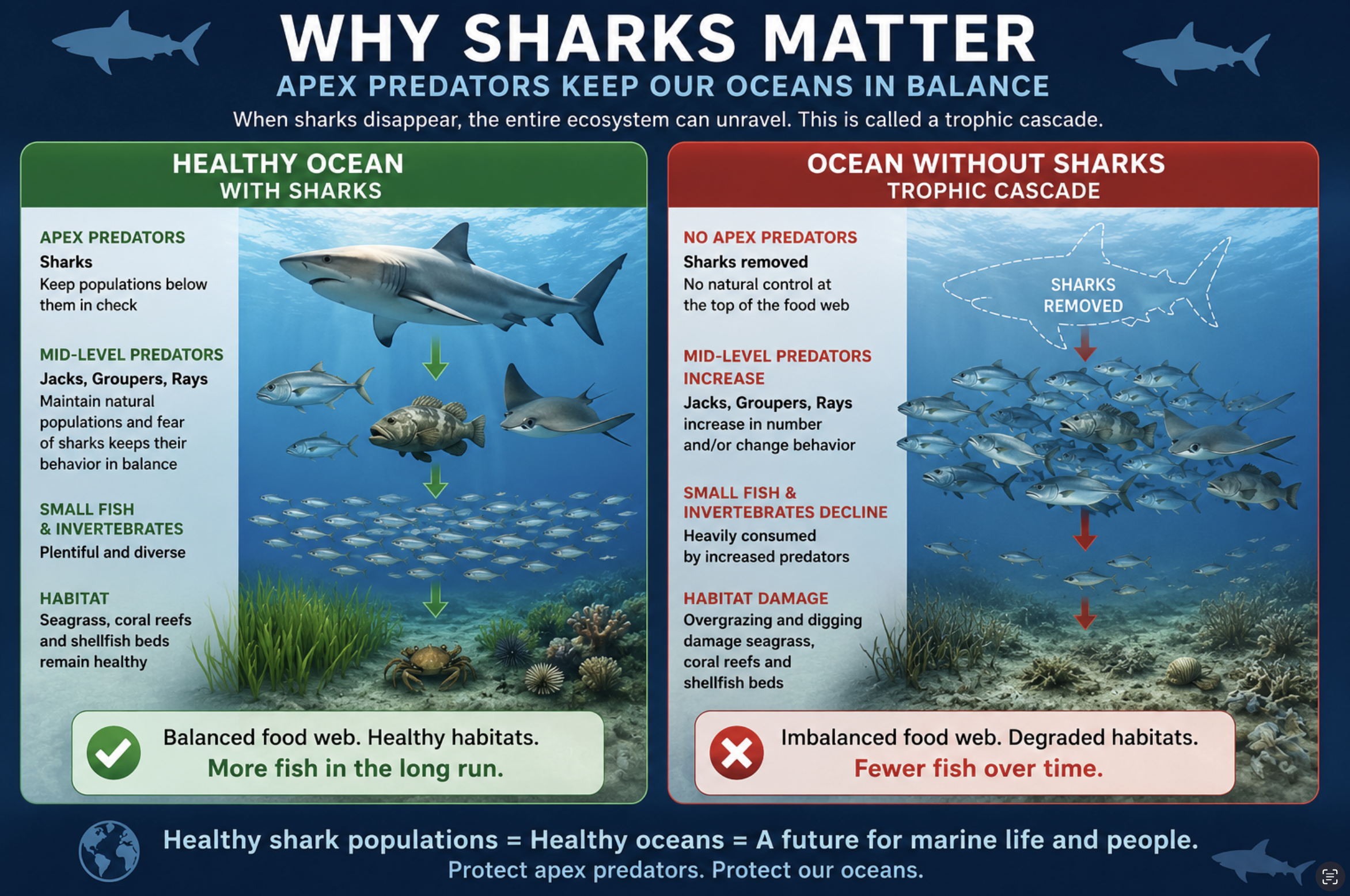
One of the biggest misconceptions about sharks is that fewer sharks means more fish. In reality, healthy oceans depend on healthy shark populations. As apex predators, sharks help maintain balance throughout the food web by regulating the abundance and behavior of the species below them.
When shark populations decline, that balance begins to unravel through a process known as a trophic cascade. Without enough predators, midlevel predators such as large jacks, groupers, or rays can increase in number or change their behavior.
These animals consume greater numbers of smaller fish and invertebrates, placing immense pressure on the lower levels of the food web. In some ecosystems, exploding ray populations have devastated shellfish beds, while in others, booming mesopredator populations have reduced juvenile fish that would have grown into the next generation of reef or commercial species.
Sharks also influence where animals feed. The mere presence of an apex predator creates what ecologists call the landscape of fear.
Prey species spend less time overgrazing one area because they must constantly remain alert for predators.
Remove sharks, and those natural behaviors change. Animals begin feeding more freely and in places they would normally avoid, which can damage seagrass meadows, coral reefs, and other critical habitats.
The result is often an ecosystem that becomes less diverse, less productive, and less resilient.
Rather than creating oceans full of fish, removing sharks can trigger a chain reaction that ultimately leads to fewer fish, degraded habitats, and weakened fisheries.
Healthy shark populations are not a sign of an ocean with too many predators.
They are a sign of an ecosystem that is functioning the way evolution intended.